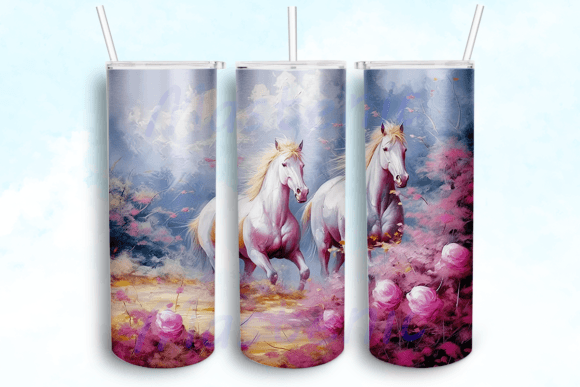
Horses 20 Oz Skinny Tumbler Sublimation
First Impressions: A Clean, Confident Horse Motif That Feels Ready for Stitching
When I opened the Horses 20 Oz Skinny Tumbler Sublimation file, what stood out wasn’t just the silhouette—it was the quiet confidence in its simplicity. This isn’t a fussy, over-rendered horse with dozens of layers or exaggerated motion lines. It’s a single, fluid profile—clean contour, balanced weight, and subtle curvature that suggests movement without sacrificing stability. As an embroidery designer who’s stitched everything from nursery onesies to boutique aprons, I immediately saw how this would translate: not as a fragile illustration, but as a sturdy, stitch-friendly motif. The design breathes well—no tight clusters of detail that’ll collapse under fill stitch density, no ultra-thin legs that vanish on textured fabric. It feels like something you’d confidently place on a custom embroidered tote bag for a local equestrian shop—or even a soft cotton tea towel for a farmhouse kitchen line.
Where It Shines: Real Projects That Benefit From Its Clarity
- Custom apparel: On a lightweight sweatshirt or unisex crewneck, this horse holds its shape beautifully—even at 3.5" wide. No distortion, no lost definition in the mane or neck curve.
- Embroidered patch: With clean outer edges and moderate internal space, it digitizes cleanly into a sew-on or iron-on patch. Great for denim jackets or kids’ backpacks.
- Baby embroidery: Paired with soft pastel thread on organic cotton onesies, it reads gentle—not loud or cartoonish—making it ideal for gender-neutral nursery decor or milestone blankets.
- Holiday and gift embroidery: I used it last month on linen pillow covers for a small-batch holiday collection. Customers responded to how “handmade but polished” it felt—no pixelation, no fuzzy edges, just confident stitching.
- Craft business & Etsy seller use: As a digital embroidery file, it’s versatile enough for printable mockups and consistent enough to build brand recognition across tote bags, aprons, and caps—all while staying true to a cohesive equestrian theme.
Where to Proceed Thoughtfully (Not Every Surface Is Equal)
The Horses 20 Oz Skinny Tumbler Sublimation is strong—but not magic. It performs best when you match its character to the right context. On stretchy fabric like ribbed knit tees? Use light cutaway stabilizer and reduce stitch density slightly to avoid puckering. On dark fabric? Test thread contrast first—some lighter grays or creams read softly, while navy or burgundy thread adds grounded warmth. On curved surfaces like caps or tapered tumblers (yes, even though it’s named for sublimation, many crafters adapt it for cap embroidery), keep the hoop size generous and avoid placing the horse too close to the bill seam. And if you’re planning fine-detail work—like adding tiny saddle stitching or hoof texture—this version doesn’t include those elements. It’s intentionally minimal, so treat it as a foundational motif, not a layered applique design.
What It Adds to Your Finished Product—Beyond Just Looks
This isn’t just about whether the horse looks good. It’s about how it affects perception. A clear, well-proportioned motif like the Horses 20 Oz Skinny Tumbler Sublimation elevates handmade presentation instantly. Customers notice the balance—the way the head aligns with the shoulder line, how the curve of the back echoes the arc of a tote bag handle. That kind of visual harmony builds trust. For Etsy sellers, it means fewer “Is this really hand-embroidered?” questions and more “I need three more in different colors.” For craft fair vendors, it translates to longer dwell time at your booth—people pause, tilt their heads, and say, “That horse *moves*.” And for small shop branding? It scales cleanly across product types without needing redesign—whether it’s stitched on a kitchen towel or printed as part of a digital embroidery file bundle in your shop.
Practical Designer Notes Before You Stitch
- Always test the Horses 20 Oz Skinny Tumbler Sublimation on scrap fabric first—especially if using textured weaves or blends.
- Check thread color contrast against both light and dark backgrounds. What reads clearly on white may disappear on charcoal.
- Review stitch density in your embroidery software—if it’s dense in the body area, consider reducing fill stitch percentage by 5–10% for breathable fabrics.
- Confirm hoop size compatibility. While the design fits standard 4x4 hoops comfortably, double-check before hooping delicate items like baby caps or silk-blend pillow covers.
- Inspect small details at 200% zoom—look for stray anchor points or overly tight corners that could snag thread.
- Test it in black-and-white mockups. If it loses personality in monochrome, it may rely too heavily on color nuance—and that’s risky for embroidery.
- Use appropriate stabilizer: tear-away for stable cottons, cutaway for knits, and lightweight fusible for sheer or slippery fabrics.
- Verify licensing terms before selling finished products or bundling the design as part of a commercial embroidery project—this listing mentions it’s for sublimation use on 20oz skinny tumblers, so confirm whether embroidery adaptation is permitted for your business model.
A Design That Works—Not Just One That Exists
In the world of Crafts and Graphics, it’s easy to collect files that look great on screen but fall apart in thread. The Horses 20 Oz Skinny Tumbler Sublimation avoids that trap. It’s got rhythm, restraint, and real-world readiness. Whether you're stitching personalized gifts for a barn wedding, building a signature line for your handmade product shop, or sourcing reliable design assets for client work—it delivers clarity without compromise. Not flashy. Not fussy. Just quietly capable. And in embroidery, that’s the highest compliment you can give a design.