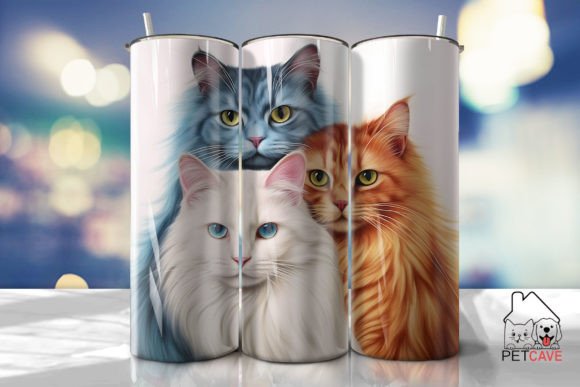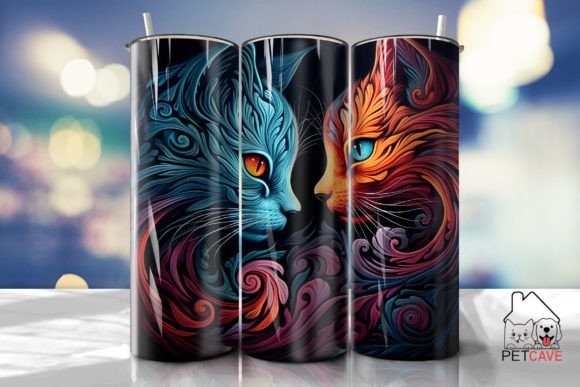
Fire and Ice Cats Tumbler Wrap
A Designer’s First Look: Playful Contrast, Not Just Pretty Pixels
When I opened the Fire and Ice Cats Tumbler Wrap ZIP file, my first thought wasn’t “cute cat”—it was “this has rhythm.” The two PNGs—one straight, one tapered—immediately signal intentionality. This isn’t a generic clipart cat slapped onto a rectangle. The composition leans into duality: flame-like swirls curling beside frosty shards, whiskers sharp as needle points, eyes that hold both mischief and stillness. As a designer who’s stitched hundreds of animal motifs for Etsy sellers and boutique clients, I know how easily feline embroidery slips into “too sweet” or “too stiff.” Fire and Ice Cats avoids both traps. It feels balanced—not overly detailed for small-scale work, not so minimal it loses personality on a sweatshirt front.
Where It Lives Best: From Tote Bag to Tea Towel
I tested Fire and Ice Cats Tumbler Wrap in a real project: a limited-run embroidered linen tea towel for a local kitchenware pop-up. We used the tapered PNG as a guide for digitizing a 4.5” wide machine embroidery design (yes—PNGs aren’t embroidery files, but they’re the essential starting point). On the finished towel, the motif sat cleanly above the hem, its vertical flow echoing the towel’s hang. Customers paused. They didn’t just say “adorable”—they said “I can *feel* the contrast,” touching the satin-stitched flame tail and the icy fill-stitched paw pads. That tactile storytelling is rare. It works equally well on structured items like canvas tote bags (where the straight version aligns cleanly with side seams) and soft, drapey pieces like cotton baby blankets—just scale down and simplify stitch density.
Real-World Fit for Your Craft Business
- Custom apparel: Ideal for sweatshirt sleeves or back yokes—its height (8.2”) gives presence without overwhelming. Avoid full-chest placement on petite tees unless resized.
- Embroidered patch: Clean outer edges and defined negative space mean crisp heat-applied or sew-on results—no fraying ghosts around the ice shards.
- Baby embroidery: Gentle enough for onesies, bold enough for nursery wall hangings. Just confirm thread colors are Oeko-Tex certified before stitching for infants.
- Holiday or wedding gift: Swap thread palettes—deep navy + silver for winter, blush + charcoal for modern bridal—and it reads instantly as intentional, not seasonal cliché.
- Etsy seller asset: Use the PNGs in printable mockups (flat lay + angled) to show versatility. Buyers understand “tumbler wrap” but also see how it translates to towels, patches, and aprons.
Where to Pause—and Why
This design shines on stable, medium-weight fabrics: linen, midweight cotton twill, brushed poly blends. But it demands attention on trickier substrates. On stretchy jersey? The tapered shape will warp if hooped loosely—use cutaway stabilizer and baste first. On dark fabric? Those fine icy lines need high-contrast thread (e.g., bright white or metallic silver), not just default ecru. And on curved surfaces—like the front of a structured cap—the straight version won’t conform; you’ll need to re-digitize or use the tapered layout with careful underlay. Also, avoid cramming it into hoops smaller than 5x7”: the flame tips and frost points lose definition below ~3.5” height.
What It Does for Your Finished Product—Beyond Aesthetics
Fire and Ice Cats Tumbler Wrap quietly lifts perceived value. Handmade products with strong visual contrast read as more considered, more professional—even when stitched by beginners using good stabilizer and proper tension. For craft business owners, that means fewer “Is this handmade?” questions and more “Who designed this?” moments. It builds trust: customers assume care went into selection, not just execution. As an embroidery reviewer, I’ve seen how motifs like this boost engagement in Etsy listings—especially when shown across three real contexts (e.g., on a tote, a tea towel, and a patch). No stock photo fakery. Just clarity, cohesion, and quiet confidence.
Practical Designer Notes Before You Stitch
- Test the layout on scrap fabric *first*—especially if adapting the PNG for applique or layered fill stitches.
- Check thread color contrast against your base fabric in natural light—not just screen light.
- Review stitch density in your digitized version: dense fills in the flame core need breathable stabilizer; open areas in the ice should stay airy, not muddy.
- Confirm hoop size compatibility early—don’t assume the 9.3” width fits your standard frame without rotation or repositioning.
- Inspect small details at 200% zoom: those whisker tips must digitize as clean running stitches, not jagged vectors.
- Try a black-and-white mockup: if the contrast holds in grayscale, it’ll hold across diverse fabric colors.
- Use appropriate stabilizer—tear-away for stable cottons, cutaway for knits or lightweight linens.
- Verify licensing terms before selling finished embroidered items or reselling digital adaptations—this listing provides PNGs only, not commercial-use embroidery files.
Final Thought: A Design That Earns Its Place
Fire and Ice Cats Tumbler Wrap isn’t background noise. It’s a deliberate accent—like choosing the right spice in a recipe. It doesn’t shout. It balances. It invites touch and second glances. For embroidery designers, craft business owners, and makers who care about how their work lands—not just how it’s made—it’s a reliable, expressive asset. Just remember: PNGs are your blueprint, not your final stitch. Respect the fabric, honor the detail, and let the contrast speak for itself.